
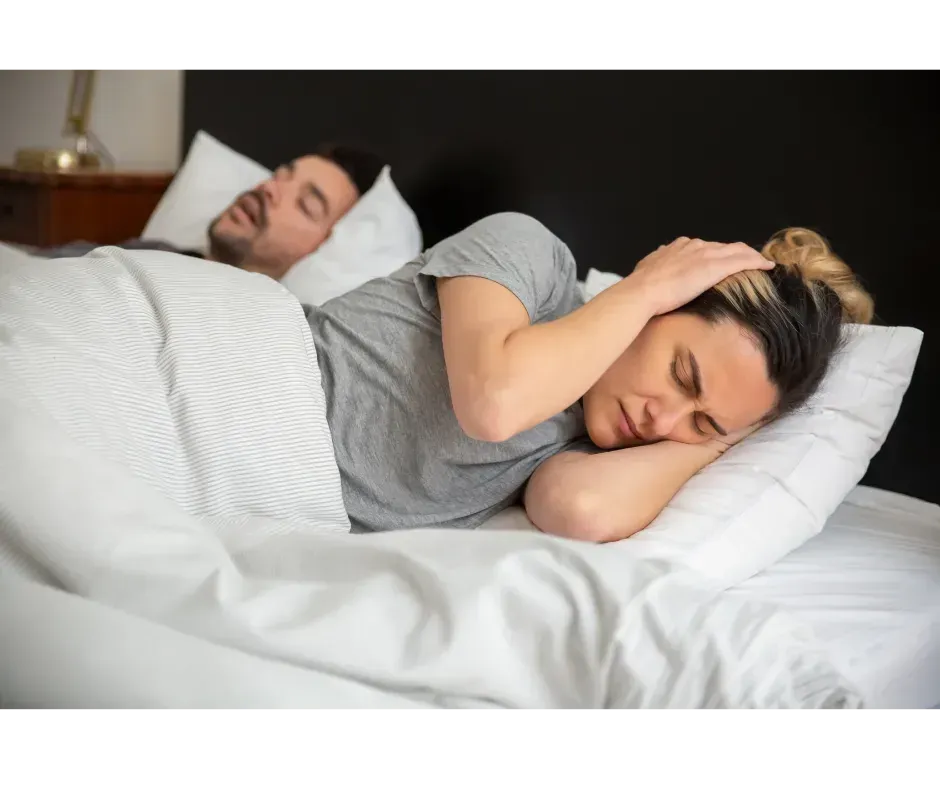
Snoring is the sound of soft tissue vibrating as air squeezes through a narrowed airway while you sleep. Plenty of snoring is harmless. But when the airway closes off repeatedly and breathing pauses, that is obstructive sleep apnea, and it affects far more than how rested you feel. Dentistry has a specific role here: a custom-made oral appliance that holds the airway open overnight.
Where the sound comes from
During sleep the muscles of the throat and tongue relax. In a naturally narrow airway, or one crowded by extra tissue, that relaxation leaves less room for air to pass. Air moving through the tight space sets the soft palate and surrounding tissue flapping, and that vibration is what you hear. Sleeping on your back, nasal congestion, alcohol in the evening, and weight gain all tend to make it louder because each one narrows the passage a little further.
When snoring may point to something more
The difference between simple snoring and sleep apnea is whether breathing actually stops. In apnea the airway collapses shut for seconds at a time, oxygen drops, and the brain rouses just enough to reopen it. This can repeat many times an hour without you ever remembering waking. Snoring that is punctuated by silences and then a gasp or snort, morning headaches, unrefreshing sleep no matter the hours logged, and daytime sleepiness while driving or reading are the patterns worth taking seriously.
Why a diagnosis comes first
Sleep apnea is a medical diagnosis, not a dental one, and it is confirmed by a sleep study read by a physician. That study can often be done at home now rather than in a lab. We are not able to diagnose apnea for you, and we would not fit an appliance for it without that confirmation, because the severity of the condition determines which treatment is appropriate. What we can do is listen to what you are describing, look at your airway, jaw, and teeth for the physical signs that often accompany it, and help you get pointed toward the right evaluation.
How an oral appliance works
A mandibular advancement appliance looks a little like two thin retainers joined together. Worn during sleep, it holds the lower jaw slightly forward of its resting position, which carries the tongue base forward with it and leaves more room at the back of the throat. The advancement is set gradually and can be fine-tuned over several weeks until snoring settles and you are still comfortable in the morning. Early on, some people notice jaw tenderness, extra saliva, or a bite that feels slightly off for a few minutes after waking; these usually ease as you adapt, and the appliance can be adjusted if they do not.
Reasons not to leave it untreated
Repeated drops in oxygen and fragmented sleep put a strain on the body over years, and untreated sleep apnea has been associated in medical literature with a long list of problems.
- High blood pressure and heart problems
- Increased stroke risk
- Harder-to-control diabetes and weight gain
- Headaches and migraines
- Memory trouble, low mood, and anxiety
- Acid reflux and nighttime tooth grinding
- In children, disrupted facial growth and attention difficulties
How the options fit together
Oral appliance therapy is generally considered for snoring and for mild to moderate apnea, or for people with more severe apnea who genuinely cannot tolerate CPAP. A CPAP machine, which delivers a steady stream of pressurized air through a mask, remains the standard for severe cases. Surgery is a further option in specific anatomical situations, and sleeping on your side, treating nasal congestion, and weight change can all help alongside any of these. Your physician guides that decision; we handle the appliance if it turns out to be part of the plan.
Not to be confused with a grinding guard
People sometimes assume any appliance worn at night does the same job. A nightguard cushions teeth against clenching forces but does nothing to move the jaw forward or open the airway. A sleep appliance is designed specifically to reposition the lower jaw. The two conditions do overlap, since grinding is common in people with disturbed breathing, so tell us if both apply to you and bring it up when you make an appointment.
Common questions about snoring & sleep solutions
Does snoring always mean I have sleep apnea?
No. Many people snore without any breathing interruptions, particularly when sleeping on their back or after a drink in the evening. Apnea involves the airway actually closing so breathing pauses and oxygen drops. Loud snoring broken by silences and gasps, morning headaches, or heavy daytime sleepiness are the signs that make a sleep evaluation worthwhile.
Can a dentist diagnose sleep apnea?
Diagnosis comes from a sleep study interpreted by a physician, not from a dental exam. A dentist can recognize signs that often accompany the condition, such as a crowded airway, a scalloped tongue, or worn teeth, and help you get referred for testing. Once you have a diagnosis, an oral appliance can be made as part of the treatment plan your physician recommends.
Is an oral appliance an alternative to CPAP?
For snoring and for mild to moderate obstructive sleep apnea, an oral appliance is often an accepted option. For severe apnea, CPAP is generally the standard, though an appliance may be considered when someone cannot tolerate the mask. Which route suits you depends on the results of your sleep study and your physician's guidance, so the two decisions go together.
Is a sleep appliance comfortable to wear?
It takes some adjusting to. In the first weeks people commonly notice extra saliva, mild jaw soreness, or a bite that feels temporarily different on waking, and these usually settle. The appliance is custom-made and advanced in small increments rather than all at once, which helps. Tell us about any discomfort that persists, since the fit and the amount of advancement can both be modified.
